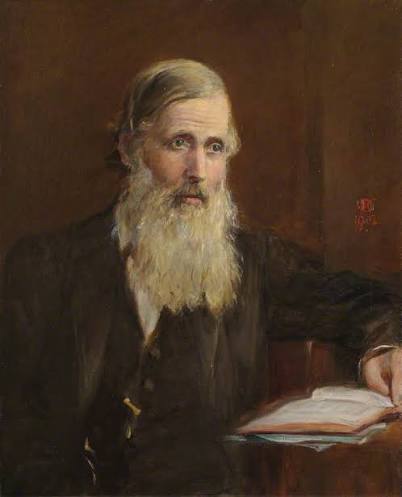
 Henry Sidgwick (May 31, 1838 - August 28, 1900) was a prominent British philosopher, educator, and social reformer whose life and work were deeply rooted in the intellectual
landscape of Cambridge University.
Henry Sidgwick (May 31, 1838 - August 28, 1900) was a prominent British philosopher, educator, and social reformer whose life and work were deeply rooted in the intellectual
landscape of Cambridge University.Queer Places:
University of Cambridge, 4 Mill Ln, Cambridge CB2 1RZ
All Saints Churchyard, Church Rd, Terling, Chelmsford CM3 2PQ, United Kingdom
Henry Sidgwick (May 31, 1838 - August 28, 1900) was a prominent British philosopher, educator, and social reformer whose life and work were deeply rooted in the intellectual
landscape of Cambridge University.
Born on May 31, 1838, in Skipton, Yorkshire, England, to the Reverend William Sidgwick and Mary (née Crofts). He was one of six children. His siblings included Arthur Sidgwick and his sister Mary ("Minnie") Benson, who became a prominent Victorian hostess and the wife of Edward White Benson, the Archbishop of Canterbury.
In 1876, he married Eleanor Mildred ("Nora") Balfour, a scientist and advocate for women’s education. The couple frequently collaborated on educational reforms and research into psychical phenomena.
Sidgwick was educated at Trinity College, Cambridge, and spent his entire adult life there. As an undergraduate, he became a member of the Cambridge Apostles, a secretive and influential intellectual discussion society.
He is best known as a major figure in the utilitarian tradition. His masterpiece, The Methods of Ethics (1874), is widely considered one of the most significant works of 19th-century ethical philosophy. In it, he explored the relationship between utilitarianism, intuitionism, and egoism.
Though he began as a classicist, he transitioned to moral philosophy. In 1883, he was appointed the Knightbridge Professor of Moral Philosophy at Cambridge.
Sidgwick was a central figure in university reform. Most notably, he was a key founder of Newnham College, Cambridge (1871), the first college for women at the university, where his wife eventually served as principal.
In 1869, he resigned his fellowship at Trinity College because he could no longer in good conscience subscribe to the Thirty-nine Articles of the Church of England, reflecting his commitment to intellectual integrity and secularization in education.
Beyond philosophy and politics, Sidgwick was deeply interested in the study of parapsychology. He served as the founder and first president of the Society for Psychical Research (1882), where he engaged in rigorous investigations of mediums, ghosts, and telepathy.
Sidgwick maintained a close and significant friendship with John Addington Symonds, a pioneer of early gay studies. Their correspondence reveals that Sidgwick provided counsel to Symonds regarding the complexities of living as a gay man in Victorian society, navigating the difficult divide between private identity and public expectations.
Henry Sidgwick died on August 28, 1900, in Cambridge, leaving behind a legacy as a rigorous thinker who sought to balance utilitarian principles with the complexities of human morality.
References:
 Strangers: Homosexual Love in the Nineteenth Century by Graham Robb |
Other references:
Support this project
This website is a passion project researched, developed, and funded entirely by me. If you find the content valuable and would like to help support the ongoing research and hosting costs, any contribution is deeply appreciated.
Thank you for keeping this independent resource alive!
My books on Amazon: Elisa Rolle's books